
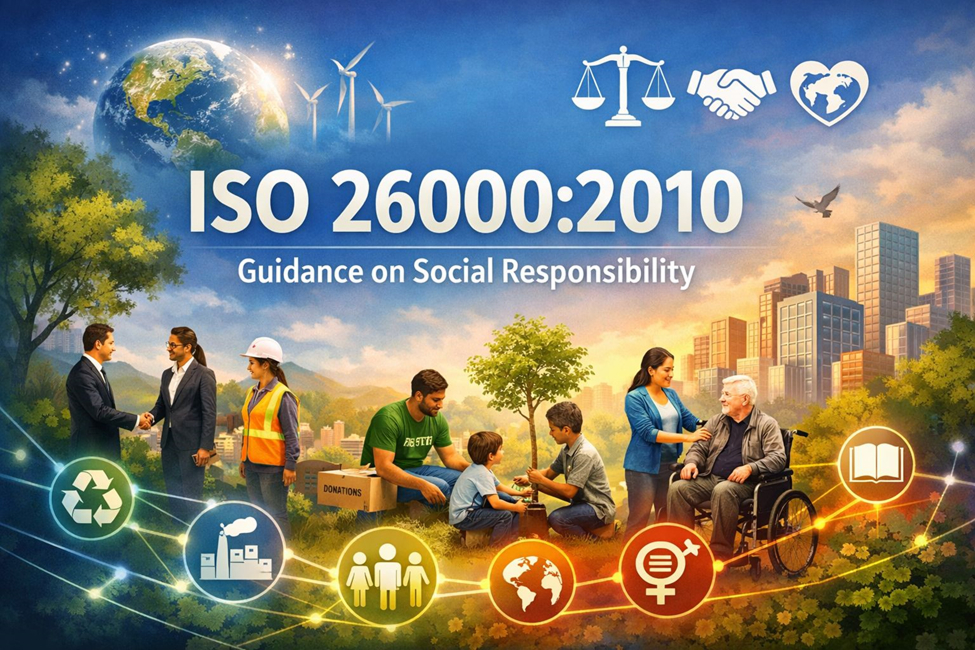
An international standard that offers guidelines for social responsibility is ISO 26000:2010. Unlike other ISO standards, it is not a certification standard but a framework to assist enterprises operate in a socially responsible way. It helps organizations contribute favorably to society, the environment, and the economy, while maintaining ethical practices and transparency.



Gap Analysis
We review your current processes against ISO 9001 requirements to identify gaps and improvement areas.
1
2
Pre-Assessment
A preliminary evaluation is conducted to ensure your system is aligned with ISO standards before the formal audit.
Internal Audit & Training
Internal audits are performed and staff are trained to ensure readiness for certification.
3
4
Final Certification Audit
An accredited auditor performs the official assessment to verify full compliance with ISO requirements.
Certification Awarded
Upon successful audit completion, your organization receives an internationally recognized ISO certificate.
5
6
Ongoing Support
Surveillance audits ensure ongoing compliance and continuous improvement.
• Promotes ethical sourcing, worker welfare, and environmental responsibility.
• Ensures patient care standards and socially appropriate behaviors.
• Encourages ethical teaching, community engagement, and sustainability.
• Supports appropriate data management, fair labor standards, and community involvement.
• increases consumer trust and supply chain transparency.
• Promotes responsible community involvement and environmental care.
• Government & Public Sector: Promotes accountability, openness, and community-focused activities.
Organizations with established sustainability and governance programs often require less implementation effort, reducing overall project costs.
Callids Global provides customized and cost-effective ISO 26000 implementation solutions based on your organization's objectives and operational requirements.
Achieving ISO 14001 Certification requires organizations to establish, implement, and maintain an effective Environmental Management System (EMS) that aligns with the requirements of ISO 14001:2015. The standard helps businesses identify environmental impacts, manage compliance obligations, reduce environmental risks, and improve sustainability performance.
Contact Callids Global today for a free consultation & quote.
Callids Global is an accredited certification body that issues internationally recognized accredited certificates to companies in a wide range of manufacturing and service industries attesting to compliance with various national and international regulatory standards.
Check the authenticity of any ISO certificate in just one click.
UAE
M Floor, Remah Towers, Al Khalidiyah,
Abu Dhabi, United Arab Emirates
INDIA
Senate Space, UR Nagar Extension, Anna Nagar West Extn, Chennai, Tamil Nadu, India - 600050
UNITED STATES
Registered Accreditation Office 8 The Green, Dover, DE, 19901, United States
Copyright © Callids Global 2023